Power (VCC)
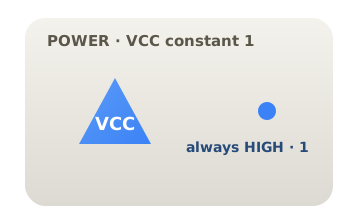
A constant source whose output is always logic HIGH (1). It represents the supply rail, VCC, the positive voltage that a logic family reads as a true or asserted level. Use it wherever a signal must be permanently 1: to tie an unused input high, to hard-wire an enable on, or to supply a constant operand to logic.
A constant logic 1
Drop a Power source and wire it anywhere: its output holds logic HIGH (1) at all times and never changes. This is the digital abstraction of connecting a node to the VCC rail, the always-on positive supply.
Tying an unused input HIGH
A spare gate input should never be left floating. Tie it to Power so it is a defined logic HIGH (1). On an AND gate a tied-high input is transparent: the output then simply follows the other, active input, as the table shows for B held at 1.
| A (signal) | B (VCC) | Y = A AND B |
|---|---|---|
| 0 | 1 | 0 |
| 1 | 1 | 1 |
An always-on enable
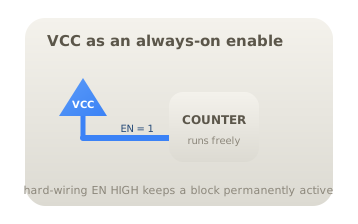
Wire Power to the enable of a counter, register, or tri-state buffer to keep that block permanently active. Because the level is a fixed logic HIGH (1), the enabled element runs freely without any external control, which is handy while bringing up and testing a design.
Citations
- Texas Instruments. (2016). SN54HC00, SN74HC00 quadruple 2-input positive-NAND gates (Rev. E) [Datasheet]. Reference 1
- Horowitz, P., & Hill, W. (2015). The art of electronics (3rd ed.). Cambridge University Press. Reference 2