Ground (GND)
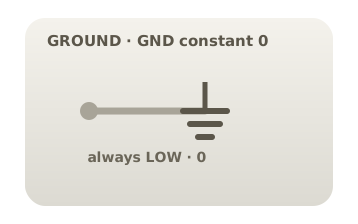
A constant source whose output is always logic LOW (0). It represents the reference rail, ground or GND, the zero-volt node that a logic family reads as a false or deasserted level. Use it wherever a signal must be permanently 0: to tie an unused input low, to hold an active-low clear asserted, or to supply a constant 0 operand to logic.
A constant logic 0
Drop a Ground source and wire it anywhere: its output holds logic LOW (0) at all times and never changes. This is the digital abstraction of connecting a node to the ground rail, the zero-volt reference every other level is measured against.
Tying an unused input LOW
Give a spare gate input a defined level by tying it to Ground, a clean logic LOW (0). On an OR gate a tied-low input is transparent: the output then simply follows the other, active input, as the table shows for B held at 0. Tying it high instead would jam the OR output permanently at 1.
| A (signal) | B (GND) | Y = A OR B |
|---|---|---|
| 0 | 0 | 0 |
| 1 | 0 | 1 |
Holding an active-low clear
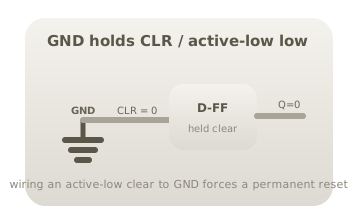
Many flip-flops have an active-low clear that resets the device whenever it is 0. Wire that pin to Ground and the element is held permanently cleared, its output stuck at 0. This is a deliberate way to force part of a design into a known reset state while you build or debug the rest.
Citations
- Texas Instruments. (2016). SN54HC00, SN74HC00 quadruple 2-input positive-NAND gates (Rev. E) [Datasheet]. Reference 1
- Mano, M. M., & Ciletti, M. D. (2018). Digital design: With an introduction to the Verilog HDL, VHDL, and SystemVerilog (6th ed.). Pearson. Reference 2