16-Segment Display
An alphanumeric display whose sixteen LED segments, including diagonals and split horizontal bars, can form every digit 0-9 and every uppercase letter A-Z, unlike the digits-only 7-segment. In PaizLogic it reads a 7-bit bus and shows the matching ASCII character. Real parts such as the Maxim MAX6954 store a full 16-segment ASCII font on-chip and drive the display from a serial word, the same idea PaizLogic hides behind a single 7-bit input.
Showing a character
Feed a 7-bit value into the display. The value is an ASCII code, so 65 shows A, 72 shows H and 48 shows 0. Where a 7-segment would be stuck on digits, the diagonal and central segments let the 16-segment draw real letters. The table lists a few characters and the segment groups they rely on.
| ASCII | Char | Segments used |
|---|---|---|
| 48 | 0 | outer ring + both diagonals |
| 49 | 1 | right verticals |
| 65 | A | top, sides, middle bars |
| 72 | H | sides + middle bars |
| 90 | Z | top, bottom, both diagonals |
Segment layout
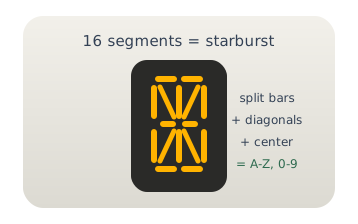
The 16 segments are the 7-segment's outer bars split in half (each horizontal into left/right, verticals kept) plus four diagonals and two center verticals forming a starburst. That geometry is why the display can bend strokes into K, M, W or X. Selecting the segment set for a character is again pure combinational logic on the 7 input bits, only wider than the 7-segment case.
Character generator with a counter
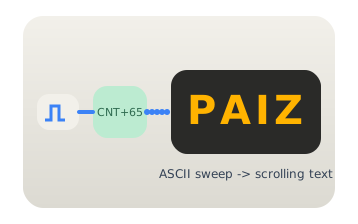
Drive the 7-bit input from a Counter clocked slowly and the display steps through the ASCII table, sweeping digits then letters. Offset the counter (add 65) and you scan A-Z. Combine several displays, each fed by an INPUT holding one ASCII code, to spell a fixed word, the seed of a scrolling-message board like those the MAX6954 was built to drive.
Citations
- Maxim Integrated. (2005). MAX6954 4-wire-interfaced, 2.7V to 5.5V LED display driver [Data sheet]. Reference 1
- Mano, M. M., & Ciletti, M. D. (2018). Digital design: With an introduction to the Verilog HDL, VHDL, and SystemVerilog (6th ed.). Pearson.