NOR gate
The NOR gate is an OR followed by an inverter: the output is 1 only when every input is 0, and 0 if any input is 1. Like NAND, NOR is functionally complete — any logic circuit can be built from NOR gates alone.
Two-input NOR
Wire inputs A and B and read Y. The output is the inverse of OR: it is 1 only in the first row, where both inputs are 0, and 0 as soon as any input is 1.
| A | B | Y |
|---|---|---|
| 0 | 0 | 1 |
| 0 | 1 | 0 |
| 1 | 0 | 0 |
| 1 | 1 | 0 |
NOR as an inverter
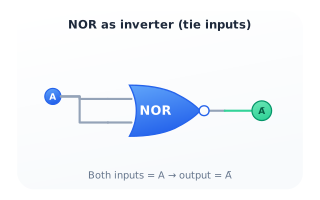
Tie both inputs of a NOR gate together and feed them signal A. The gate then computes NOT(A + A) = Ā, acting as an inverter. This is the building block that shows NOR — like NAND — can implement any logic function.
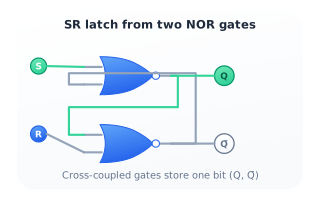
SR latch from two NOR gates
Cross-couple two NOR gates to build an active-high SR latch. Pulsing S high sets Q to 1; pulsing R high resets Q to 0; holding both low preserves the stored bit. Setting both inputs high at once is the forbidden state. This is the textbook memory element from which flip-flops are derived.
Citations
- Sheffer, H. M. (1913). A set of five independent postulates for Boolean algebras, with application to logical constants. Reference 1
- Shannon, C. E. (1938). A symbolic analysis of relay and switching circuits. Reference 2