AND gate
The AND gate outputs 1 only when every input is 1; if any input is 0 the output is 0. It implements logical conjunction (A · B) and is the building block for enabling, masking, and coincidence detection.
Two-input AND
Wire two inputs A and B to the gate and read Y. The lamp lights only in the last row, where both inputs are 1. Every other combination leaves Y at 0.
| A | B | Y |
|---|---|---|
| 0 | 0 | 0 |
| 0 | 1 | 0 |
| 1 | 0 | 0 |
| 1 | 1 | 1 |
Gating a data line
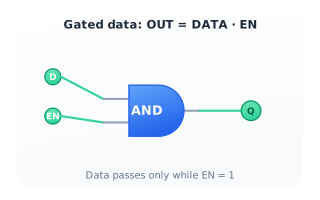
Feed a DATA signal and an ENABLE signal into an AND gate. The data reaches the output only while ENABLE is 1; when ENABLE is 0 the output is forced to 0. This 'enable' pattern is how AND gates gate clocks, strobe registers, and mask bits.
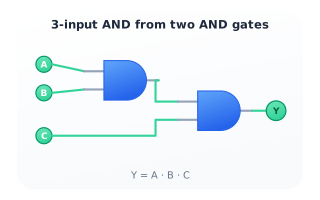
Three-input AND from two gates
Because AND is associative, A · B · C can be built by feeding the output of one two-input AND into a second AND together with C. The final output is 1 only when A, B, and C are all 1. The same cascade extends to any number of inputs.
Citations
- Boole, G. (1854). An investigation of the laws of thought, on which are founded the mathematical theories of logic and probabilities. Reference 1
- Shannon, C. E. (1938). A symbolic analysis of relay and switching circuits. Reference 2