Demultiplexer (DEMUX)
A demultiplexer is the inverse of a multiplexer: it forwards a single data input to exactly one of several outputs, chosen by the select lines. All non-selected outputs stay inactive. A DEMUX with n select lines drives one of 2^n outputs and is the basic data-distribution element.
1-to-2 demultiplexer
The single input D is routed to Y0 when S=0 and to Y1 when S=1; the other output holds 0. The DEMUX decides where the data goes.
| S | Y1 | Y0 |
|---|---|---|
| 0 | 0 | D |
| 1 | D | 0 |
1-to-4 demultiplexer
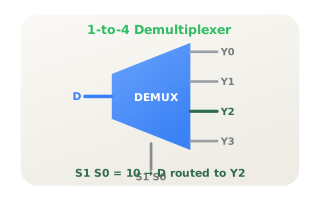
Two select lines route D to one of four outputs. The code 10 sends D to Y2 while Y0, Y1 and Y3 stay low. A decoder plus an enable input behaves exactly like a DEMUX.
Serial data distributor
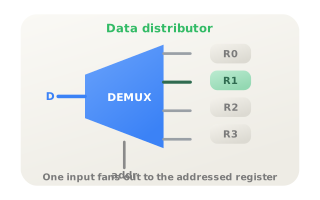
Feeding an address counter into the select lines turns a DEMUX into a de-serializer: successive bits or words on the single input are steered into different registers or channels in turn. This is how one shared line loads several destinations.
Citations
- Shannon, C. E. (1938). A symbolic analysis of relay and switching circuits. Reference 1
- Texas Instruments (2003). SN74HC138: 3-line to 8-line decoders/demultiplexers [Data sheet]. Reference 2
- Mano, M. M., & Ciletti, M. D. (2018). Digital design: With an introduction to the Verilog HDL, VHDL, and SystemVerilog (6th ed.). Pearson.